THE DAY-TO-DAY ENIGMA... the life of a soldier…
The most hidden, or least shared, part of my career in the Armed Forces was, by far, the day-to-day life that I lead in camp (Especially as a soldier). The pure reason for this was that no one was really interested in the daily ongoings, they were always more interested in the “fun” stuff like Afghanistan, Iraq, or the plethora of adventure training exercises I undertook through my life in the Forces.
In the mundane, occasionally, you find the unique elements that make something special – this, in part, was true about life in the Army too.
The Day-to-Day Enigma… The Life of a Soldier…
The invention of “The Monday Blues”…
The idea of the “Monday blues” had to have been created by someone in an Armed Forces around the world. Whilst everyone feels the sudden realisation that the weekend is over and “adulting” must start again, this is significantly more felt by a soldier. You go from a weekend of freedom, and choice, back to a place where you are likely to be shouted at, a lot, undertake meaningless cleaning activities and spend a significant amount of your time rushing to get somewhere, only to be left waiting.
I think that, fundamentally, the realisation that when you signed on the dotted line all that time ago in the recruitment office really meant that you were signing youTr life over to the Forces hit hardest when you had a great weekend, or leave, away from camp. Apart from that, life as a soldier was easy – You knew where you needed to be, at what time and what you were going to be doing, for the most of it. Life during the week required very little thought and forward planning…
The ingredients to a day were relatively simple… You start with a cup of physical training (PT), add in a dash of cleaning tasks, throw in a pinch of Law of Armed Conflict (LOAC) lessons or some weapon familiarity training, cover it in a good helping of shouting and you end up with a completed day… See, simple…
Your day ran pretty much like it would in any other job…
- 06:00: Reveille (Wake-up call)
- 06:15: PT
- 07:30: Breakfast
- 08:15: Day Serial 1
- 10:00: Coffee/Smoke Break
- 10:30: Day Serial 2
- 12:00: Lunch
- 13:00: Day Serial 3
- 14:30: Coffee/Smoke Break
- 15:00: Day Serial 4
- 17:00: Extra-Curricular Activities
- 18:30: Dinner
After a weekend of overindulgence, Monday morning PT was not something to look forward to. To this day I still believe that to become a successful Army Physical Training Instructor (PTI) you must have 3 things… A high level of fitness, a comedic grasp of the English language and, most importantly, have a significant interest in sadism. These sessions were horrific! Not only were you coming of a significant weekend bender, but you were still coming to terms with the fact that you were, once again, being shouted at for a week and now you were having to deal with that and the fact you had to do it whilst running around carrying someone through a stinking puddle… I had always questioned my choice in career these days…
Fundamentally, I understand the irony of comparing life in the Forces to a normal job or career – in real terms, what I should be liking it to is what I imagine a university student experiences living on campus, but with guns and you run around a lot… Being a soldier, living in barracks, was a strange situation – you have great responsibility because you undoubtably will carry around a firearm and the lives of your teammates could rest on your actions crossed with no awareness of what actual adult responsibilities were for e.g., Making sure you budget so that you have food on the table and a roof on your head.
Mondays were heralded by stories of conquests and quarries from the weekend. Groups of soldiers would gather and regale each other with their tales on how they bested an opponent in a forgotten den of debauchery in their hometown and then how they proceeded to conquer multiple ladies in a single night, each story becoming more elaborate and fascicle than the previous… I learnt quickly that the people with the biggest egos, and mouths were the ones lost in the biggest fantasies. Whilst strewn with blatant lies these musings were always cause for great morale and never something to be missed.
Hurry up! And wait…
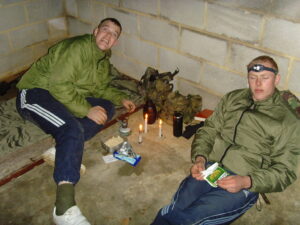
There is nothing truer to a soldier than the understanding of the term, “Hurry up and wait.” Throughout my time as a soldier, I can count on one hand the times we were rushed for a valid reason. “Hurry up and wait” started very early in my short career as a soldier (Make no mistake, it happened as an Officer too though – but that will come later in the blog).
“Hurry up and wait” both in concept and in practice is a thing of pure enjoyment, for those outside of it to behold. The art of rushing an individual only to have them stand waiting for said person to arrive, or give them their next set of tasks, is an art perfected by both Senior Non-Commissioned Officers and Senior Officers alike (The latter being the worst culprits, but I feel more by circumstance than design).
Within the Forces there is a rule – Be ready 5 minutes before you were told to be ready by… This, I am sure, extends across the breadth of the Armed Forces across the World. The constant need to be prepared, and on time, causes a phenomenon that only Service personnel will understand which is a compounding of that time to a point that you are stood waiting 20 minutes before the 5 minutes you needed to be there by… The “5 minutes before 5 minutes before” phenomenon plays out like this…
- Company Commander to Company Sergeant Major: I would like the Company on parade at 12:00hrs
- The assumption here is that everyone would be ready at 11:55hrs for whatever he needed them for.
- Company Sergeant Major to Platoon Sergeants: I would like your Platoons on Parade at 11:55hrs.
- The CSM’s assumption is that the Platoons are inevitably going to be late, so he would expect them to be there at 11:50hrs (Which means that they would comfortably be there for the CO’s 5 minutes before time).
- Platoon Sergeants to Section Commanders: I would like the Sections on parade at 11:50hrs (Which is actually 11:45hrs going by the 5 minutes before rule).
- Section Commanders to the Guardsman (Or Privates – this worked everywhere): You pricks better be on parade by 11:45hrs or you will all be on extra duties. Do you c*nts understand?
- The assumption here is that the Guardsman/Privates will inevitably mess it up and by having them on parade by 11:40hrs will ensure they meet any of the previous timelines…
As you can see in the above scenario – the potential for “Hurry up and wait” is exponential depending on the seniority of the person giving the initial time to be ready.
For all it’s detracting factors, the one thing that is abundantly clear when soldiers are forced to stand around for long periods of time is the potential for complaints. As a junior soldier, it is part of your remit to voice your complaints at any point you deem fit. To that end, I have now established that NO ONE can complain like a soldier. There have been instances in my life where I have stood in awe observing something beautiful or unexplained, but nothing quite filled me with that sense of amazement which I felt when listening to the sheer volume of complaints, about relatively insignificant stuff, that would pour out during the wait prior to a briefing or tasking.
Language was always an interesting challenge, especially for someone who had a relatively good grasp on English as I did not think initially that I would struggle to understand “English” in England. As part of a very Northern Regiment – to define this, the Coldstream Guards typically recruited from the North of England – my understanding of the language was constantly challenged by the regional dialects of the Mackems (From Sunderland), the Smoggies (From Middlesborough), the Tackems (From who knows where) and Geordies (From Newcastle). If you are confused, worry not – so was I for a long time, these are what the names to which the people who originated from the areas know each other and themselves by (They all have historical stories if you are interested in investigating further). To be part of this Regiment meant that I needed to adapt my understanding and constantly learn what may be being asked of me. “Alreet” meant “alright, “awe (Pronounced phonetically)” meant “no”, “canny” meant “good”, “gannin yem” meant “going home” – I could go on, but it is safe to say that no dictionary or thesaurus could help me.
Sports, and more…
There were, fortunately, some days within the week that you looked forward to more than others. Friday, being the obvious one, and Wednesdays being the other.
Wednesdays heralded the arrival of the “Sports Afternoon”… This unique day meant that, in real terms, your workday ended at 12:00 and you were given free rein to go and undertake a sporting activity of your choice within the wider area of your camp. There were the normal stalwarts which the bulk of people undertook – Rugby and football (Soccer if you, like me, are South African), however occasionally you were blessed by an abundance of choice within your local area – Skydiving, pool or snooker, swimming (In an indoor pool obviously – it was the UK after all) and, for some of the more “necky”/genius soldiers, pub darts. The military was inevitably great in allowing you to undertake activities that were both good for you and good for your morale and if you took part and made some effort, you were left to your own devices.
Sports afternoon, for some, was vastly different though. My memories take me back to one Wednesday whilst based in Windsor Barracks. Returning from the Regiment’s Rugby practice, I heard a commotion down the corridor. As it was customary for everyone to stick their heads out the doors to investigate, I followed the trend. Their stood one of the Section Commanders at the door of a new Guardsman notorious for skipping sports afternoon to hide in his room and undertake other, whilst strenuous, non-sport related activities. His room still dark, standing clad in only a pair of concerningly stained pants (Underwear) trying to explain to a visibly enraged Lance Corporal that he was not doing what he had been evidently caught doing on an afternoon where sport was the priority. Understandably this did not go down well with the Lance Corporal who proceeded to frog march the Guardsman, whilst scrambling to put on some clothes, to the Company offices for some delightful AGAI (Disciplinary) action… I would be lying if I said situations like this only happened occasionally as this happened in camp, on operations and, where possible, on exercise (Not the same person all the time though)… A Guardsman’s libido is evidently something very difficult to control.
Sports, much to my benefit, was something which the Army invested a significant amount of effort and funding into. Having played a competitive level of rugby in South Africa it was natural that I found myself continuing that in the Forces. For me, being able to play a sport, which I loved, whilst it being paid to do it was an outcome, I had only imagined professional level athletes would achieve… This was not the case. Time off to train, being excused from duties and free trips around the world were some of the perks associated with Army sports – it was not something you would say no to. What it also meant was that you fought against people from across the breadth of the Forces on a battlefield only to be best mates with them in the bar afterwards in the true spirit of the game. The comradery and competition are 2 elements of my past life which I still miss to this day…
There were several activities throughout the year which pitted the elements of the Regiment against each other in a competition to see who the best Company was. Rugby, boxing, tug-of-war, cross-country, swimming and march and shoot… It was safe to say that if you wanted to work, but not work, then the sporting life was for you. These competitions happened through the year usually culminating with the Inter-Company Boxing which was a well-attended and well-respected even which saw the victors celebrating in the Sergeants’ Mess for the evening. This gave us Guardsmen a glimpse into what life as a Senior Non-Commissioned Officer could be like… It is safe to say that my views on responsibility vs lack of “adult” responsibility transcended rank…
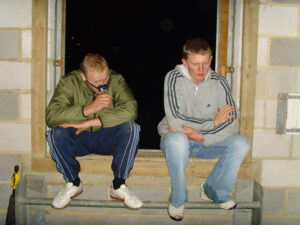
Brussel sprout fights and lava-based mince pies…
It would be an injustice, considering this time of year, for me not to touch on Christmas as an in-camp soldier.
With the coming of the festive break comes one of the traditions I have had the privilege of experiencing from both sides (Soldier and Officer). The annual Christmas Lunch is one of the traditions celebrated throughout the Armed Forces, by all ranks. The format is simple – The troops are seated, and their food is then served to them by the Officers and Senior Non-Commissioned Officers of the Regiment. The Commanding Officer (CO) says some words of encouragement to the Regiment, congratulating them on the hard work they have put in and asking that they keep the tempo into the new year after their well earnt break. The CO and Officers then leave the mess hall. The Regimental Sergeant Major (RSM – He is the angriest/most senior Warrant Officer in the Regiment) then too congratulates the soldiers on the year ending his speech with the usual warning… “DO NOT THROW FOOD AT EACH OTHER ONCE I HAVE LEFT THIS HALL!”… I undoubtedly assumed this was more of a challenge to the soldiers than a warning, and the truth is that I imagine everyone saw it that way…
To set the stage on what happened next, you need to understand what the Christmas Lunch was made up off…
- Turkey
- Gammon
- Roast Beef
- Carrots
- Yorkshire Pudds
- Brussel Sprouts
- The hottest mince pie in all the land…
Before the RSM had even disappeared out the door the first flurries of mince pies were already in the air. The aim was to ensure they hit a target while they were still hot enough to cause effect on the intended/unlucky target. At that point it typically became a Company vs Company fight, tactically matching your targets to an intended element of food. Once the mince pies were expended you then worked through the ample serving of Brussel Sprouts and moved onto the carrots. Occasionally a ground led assault with slabs of beef would be launched against an already engaged target set. You would think that having 4 Companies in a Regiment would mean there would be an even allocation of warring factions, this was not the case. Unfortunately for the Headquarters Company it was apparent that the typical 3 vs 1 approach adopted by the British Army in warfighting transcended the battlefield into the mess hall. The 3 Companies inevitably turned on the overpowered Headquarters showing little mercy to their brother soldiers.
With minor burns, a few bruised egos and a hefty dose of morale, this occasion marked the end of a long year and the start of some well earnt down-time for most of the Regiment.
Life, however, is very different for different people. This was more apparent in the multitude of Commonwealth soldiers who serve in the Armed Forces. South Africans made up a significant part of this… At the peak of our representation in the Army there were around 4000 serving soldiers and Officers who hailed from the beautiful land of far-far South of the shores of Blighty. We existed in every arm of the Army and, for the majority, delivered a notable contribution to those areas we served in. Christmas was typically spent with friends or serving on the Rear-Guard which looked after camp while everyone was on leave – This was a great way to enable you to take leave in a cheaper flight-time of the year.
With it being a quiet time of year, your guard shifts were easy and usually included some “delicious treats” from the cookhouse in the form of mystery brown paper bags containing, usually frozen, sausage rolls and an assortment of biscuits – fortunately for us most food outlets delivered to the camps. We feasted on pizzas, watched pirated movies, and did the occasional patrol around camp… It wasn’t the hardest we had worked through the year. Downtime was spent doing exercise, playing computer games, or exploring the local town. We were lucky as we, being based in Windsor, got to experience a white Christmas in an exceptionally beautiful part of England.
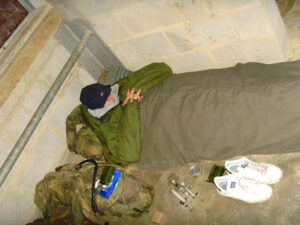
Life as a soldier coming to an end…
I cannot really say that life as a soldier was overly hard nor was it easy, what I can say is that it was challenging. Having experienced life within, what is, the base rank of the Army, being challenged and having been given the room to grow with people who I would never had imagined I would get the honour of becoming brothers with, really made me appreciate the diverse nature of what I had undertaken in leaving my home in South Africa.
With my time in the Guards slowly coming to an end, the closure of another chapter in my life would signal the start of another in my journey to become an Officer which had all started in a conversation 3 years prior in Iraq. There is still a small matter of an exercise in South Africa before I get to that path though…
It was always apparent that the spirit of the Armed Forces well and truly sat within the people who served inside of it. Whilst there is significant glory and heritage in the history of the various Regiments, their future is held in the hands of the people who I stood next to, and now continue to stand within the various ranks therein.
If I took anything away from my time as a soldier that I try to use in every fascit of my life, both professional and personal, it is this:
- Ensure your people are trained, their morale and drive are maintained, and they feel valued.
- People make an organisation great, not the other way around.
- Communicating too much is preferable to too little…
- Talk to people when you are struggling with something. Talk to people when you are frustrated with something. Talk to people when you are happy about something.
- We lose too many people because they feel they cannot openly talk about stuff in their lives.
- Be open to change.
- Be open to new experiences.
- Be true to who you are and what your values are.